


How to: develop Business English

You can communicate in English. I know this because you're reading this blog post.
So what is the difference between the English you learnt at school and Business English?
Business English is formal English. We use it at work to:
The English you learnt at school helped you to pass your exams. You can use it when you go on holiday, to sing along to the lyrics of a pop song or just to chat with someone.
The English you need to use at work is different and the more you can master Business English the more confident you will feel when talking to international colleagues, customers and suppliers.

Be clear
It is very important to get our message across clearly and precisely. We want to avoid misunderstandings and the need to ask for clarification. We already receive too many emails so try to have your message understood first time around. You don't need to use complicated words and long sentences to show that you know what you are doing. As long as the message that you need to deliver is understood, that's the main aim.
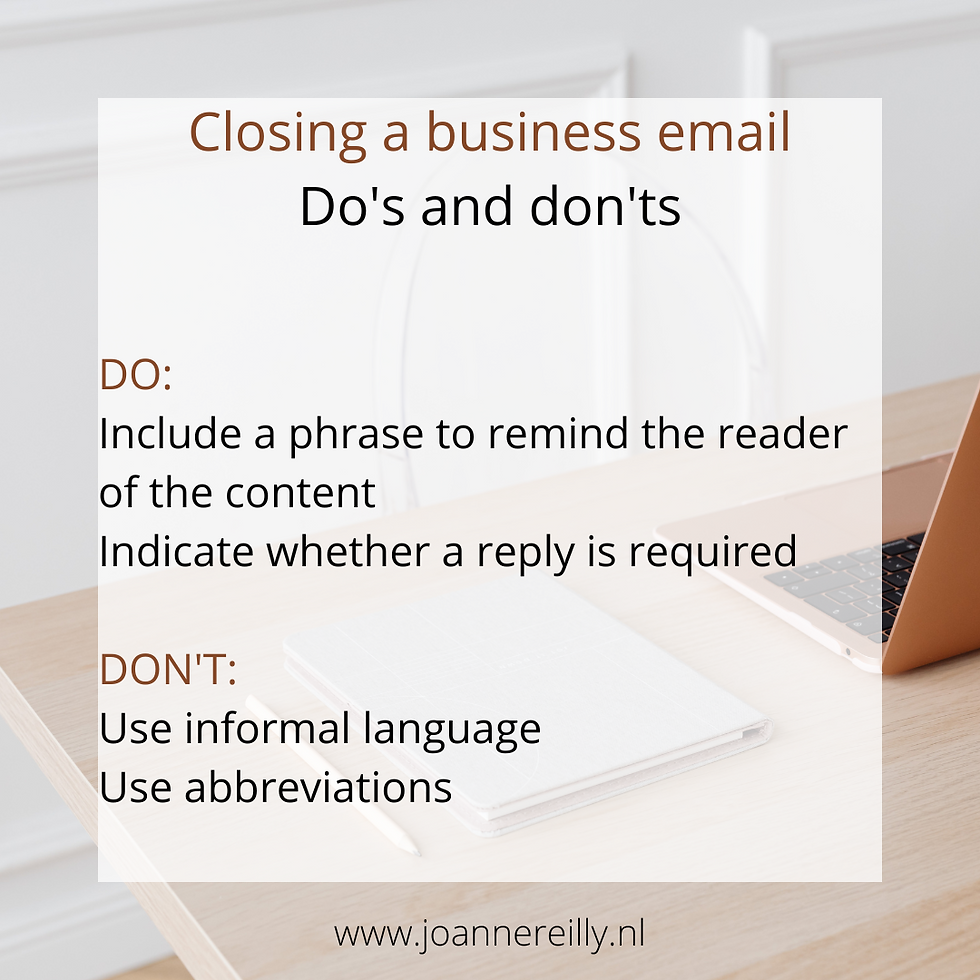
Try to avoid using acronyms unless you have already explained what they mean. Often we can make assumptions that everyone knows what EOD (end of day) means so we just use it. Assumptions are often incorrect so use clear language and if you have to use acronyms explain what they mean.
Communicate professionally
In other words, be formal in the language you use. Don't speak to your colleagues, customers and suppliers in the same way as you would speak to your friends. Don't use slang terms but instead use professional language. Slang terms are used in casual conversation such as calling someone a 'couch potato' or saying that someone is 'sus'. These types of words are not professional and shouldn't be used in Business English correspondence.

Use specialist vocabulary
This will probably be vocabulary that you didn't learn at school, but instead is specific to your role in accounting, marketing or engineering for example. Words such as depreciation, inventory and revenue will be relevant to you as an accountant. In marketing words such as fast moving consumer goods or direct marketing will be used. These are words you should take time to learn so that you can use them correctly in an email or conversation.
There will be times in our careers when we encounter new words, even in our own language. It is important to keep up to date with language developments to ensure we understand each other. This is especially true when talking to younger generations, who are more in tune with language developments through the use of social media (I speak from experience here!).
Show cultural awareness
It is important to understand the cultures we are working with so that we can communicate with them appropriately. A British person values politeness, an American will value enthusiasm, a Dutch person appreciates directness. By recognising where other cultures are coming from we can more easily understand why they have communicated in a particular way. Just because a British person is being polite it doesn't mean they are not excited or annoyed about something.
Talk to me about Business English coaching.
Melissa completed a Business English course and this is what she had to say:
"I really enjoyed the English lessons with Joanne. She is such a sweet teacher! The lessons were completely adapted to tasks I have to do at work.
Whenever she saw that I was struggling with something, extra attention was paid to it.
I have become much more confident with my English communication.
I definitely recommend Joanne Reilly!"


Comments